A Guide to Slow COMT
Why Your Brain and Body May Struggle to Clear Stress Chemistry

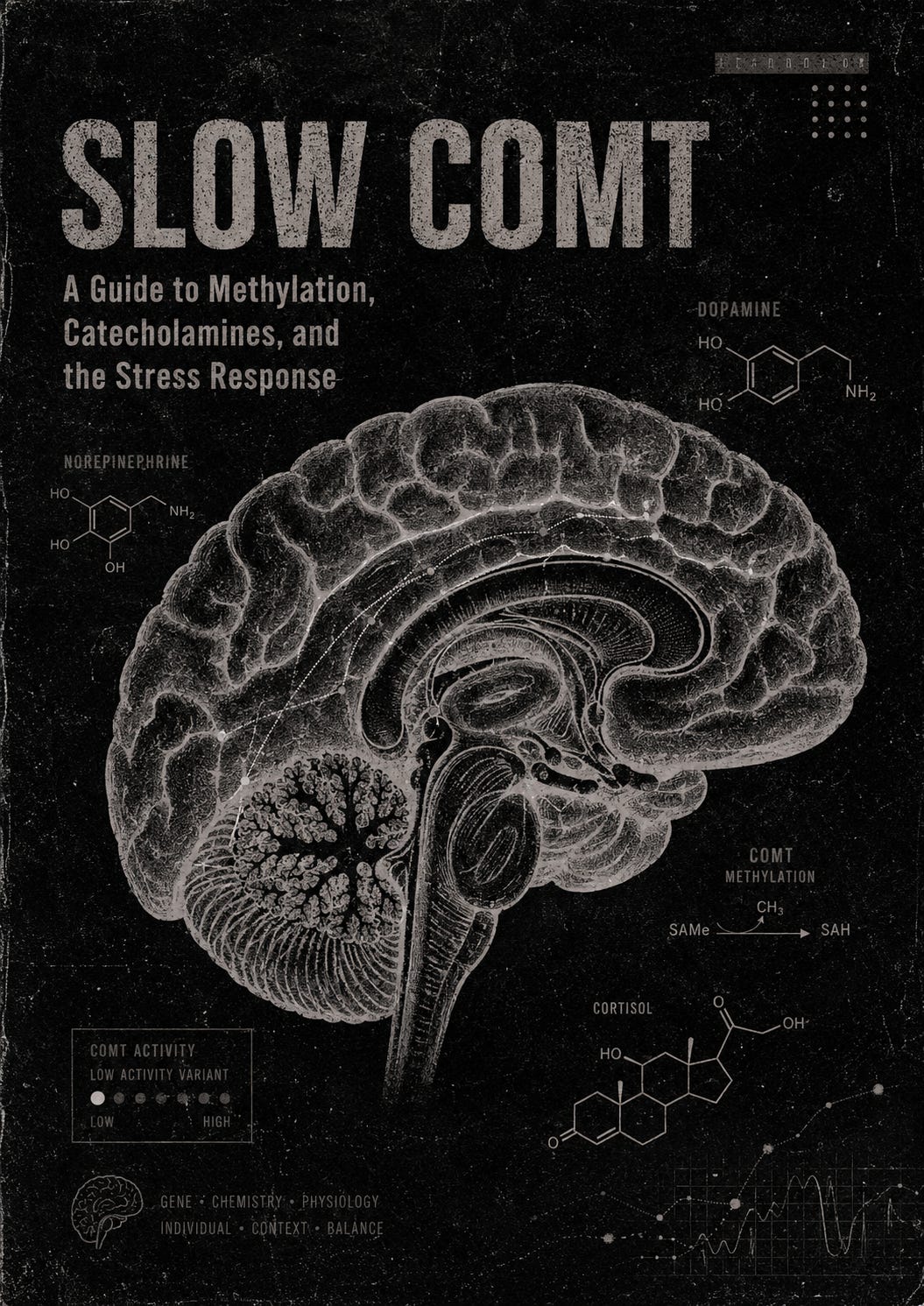
Your body can stay in stress mode long after the trigger has passed.
A hard conversation ends at 2 p.m., then midnight comes and your chest is still tight, your thoughts are circling, and sleep feels far away. One cup of coffee feels clean and focused on Monday, then sends you into jitters on Friday after a week of poor sleep. A hard workout, a deadline, a stimulant pre-workout, an ice bath, or a hormone shift can push the same body that usually feels capable into a state that feels over-alert and difficult to settle.
That pattern sends many people searching for slow COMT.
The internet will tell you COMT has something to do with dopamine, adrenaline, estrogen, methylation, caffeine sensitivity, anxiety, PMS, rumination, and feeling “wired but tired.” That search can be valuable because COMT really does connect to dopamine, adrenaline chemistry, estrogen metabolites, methylation, and stimulant sensitivity. The danger begins when one gene variant becomes a life script and people start fearing coffee, exercise, estrogen, methyl donors, or their own stress response.
When people talk about slow COMT, they usually mean this: the body may process certain stimulating catechol chemicals more slowly than average.
Those chemicals include dopamine, norepinephrine, epinephrine, and catechol estrogens. They affect focus, vigilance, adrenaline-like activation, stress response, and hormone-related symptoms. COMT is one enzyme that helps process them.
Symptoms tend to show up when your body is making or taking in more of those chemicals than it can process and recover from.
That can happen after poor sleep, too much caffeine, stimulant supplements, intense exercise, psychological pressure, hormone shifts, constipation, alcohol, or aggressive methylation support. The gene is part of the story, but sleep, food, medications, hormones, liver function, gut function, bowel movements, minerals, and nervous-system state all shape the final pattern.
Before we go further, a quick safety note. This article is educational and should not be used as medical advice, a diagnosis, or a replacement for individualized care. This topic overlaps with psychiatric medications, stimulant medications, hormone therapy, Parkinson’s medications, pregnancy, fertility treatment, hormone-sensitive conditions, panic disorder, bipolar disorder, severe insomnia, arrhythmias, hypertension, migraines, liver disease, and kidney disease. If any of those apply, keep this article in the category of education to discuss with a qualified clinician.
1. Why some people stay in stress mode for too long
A lot of readers who find this topic already know the sentence they have been trying to explain for years:
“I can handle stress, but I cannot come down from it.”
Coffee might be fine on a calm day and too much during a week of poor sleep and pressure. Exercise can feel steadying when life is stable, then overstimulating when hard training is combined with fasting, caffeine, and emotional stress. Mild pressure can sharpen focus. Too much stimulation can push the same person toward obsessive thoughts, inner agitation, or overwhelm.
Some people notice the pattern more around ovulation, PMS, perimenopause, or hormone therapy. Others notice it with methylated B vitamins, SAMe, pre-workouts, tyrosine, stimulants, green tea extract, cacao, alcohol, high-intensity training, or sleep loss.
COMT should not be treated as the only explanation. Hyperthyroidism, low blood sugar, iron dysregulation, trauma physiology, sleep apnea, POTS or dysautonomia, histamine or mast-cell issues, medication effects, perimenopause, anxiety disorders, infection, inflammation, overtraining, and ordinary life overload can look similar.
Still, COMT matters because it helps process several chemicals involved in focus, stress arousal, adrenaline symptoms, and estrogen metabolism.
Some people are sensitive to the chemistry that stress leaves behind.
2. How COMT turns down catechol chemistry
COMT stands for catechol-O-methyltransferase. It is an enzyme, and enzymes help chemical reactions happen in the body.
COMT helps change catechol molecules by adding a methyl group to them, which is one step in processing them. A catechol is a chemical structure found in several high-impact molecules, including dopamine, norepinephrine, epinephrine, and catechol estrogens.
These compounds are quite important for human physiology as we know it as well.
Dopamine helps shape motivation, reward, focus, working memory, learning, movement, and salience. Norepinephrine is involved in alertness, vigilance, attention, threat readiness, and sympathetic nervous system activation. Epinephrine, also called adrenaline, is one of the body’s main “go now” chemicals. Catechol estrogens are estrogen metabolites that still need to be processed, neutralized, and removed.
COMT is one enzyme that helps metabolize catecholamines, such as dopamine, norepinephrine, and epinephrine, as well as catechol estrogens. It catalyzes O-methylation of catechol-containing substrates using SAM as the methyl donor, with magnesium or divalent-cation-supported enzyme chemistry involved in the reaction.
COMT attaches a methyl group to catechol chemicals so the body can change them into forms that are easier to process and remove.
That is why this enzyme becomes relevant when the nervous system feels like it will not shut off.
3. What COMT helps metabolize
People love calling COMT “the dopamine gene.” The nickname is memorable, but dopamine is only one part of the story.
COMT participates in the metabolism of several catechol-containing compounds, including dopamine, norepinephrine, epinephrine, L-DOPA and other catechol drugs or compounds, and catechol estrogens.
Dopamine
Dopamine is involved in motivation, reward, focus, working memory, learning, movement, and salience. It helps your brain decide what matters.
COMT appears especially important in the prefrontal cortex. This is the part of the brain involved in planning, impulse control, emotional regulation, decision-making, working memory, and executive function. Human postmortem brain research has found that COMT Val158Met variation significantly affects COMT protein abundance and enzyme activity in the prefrontal cortex.
Because dopamine regulation is regional and situation-dependent, prefrontal dopamine, striatal dopamine, and urinary dopamine metabolites should not be treated as interchangeable. A gene variant cannot give you a complete map of neurotransmitter activity.
Lower COMT activity may affect dopamine signaling in certain tissues and situations, especially in the prefrontal cortex.
Norepinephrine
Norepinephrine is involved in alertness, vigilance, attention, threat readiness, and sympathetic nervous system activation.
When norepinephrine rises appropriately, you feel awake and responsive. When it stays high or the body keeps producing more of it, you may feel watchful, tense, keyed up, reactive, or unable to settle.
COMT participates in norepinephrine metabolism, along with other pathways.
Epinephrine
Epinephrine, also called adrenaline, is the more body-wide stress surge catecholamine.
It is one of the body’s main “go now” chemicals.
A strong epinephrine surge can feel like shakiness, a racing heart, heat, urgency, chest tightness, panic-like activation, or the sense that your body is preparing for something intense.
COMT participates in catecholamine metabolism, but it is only one pathway involved in clearing dopamine, norepinephrine, and epinephrine.
Catechol estrogens
Estradiol and estrone can be metabolized into catechol estrogens, including 2-hydroxyestradiol, 4-hydroxyestradiol, 2-hydroxyestrone, and 4-hydroxyestrone. COMT methylates catechol estrogens into methoxyestrogens.
That is why COMT connects stress chemistry with estrogen metabolism. COMT is one route for clearing catechol estrogens. If COMT activity is lower and estrogen or catechol-estrogen burden is higher, that route may become more relevant.
4. What “slow COMT” means
When people say “slow COMT,” they are usually talking about lower COMT enzyme activity, often discussed around the COMT Val158Met variant, also called rs4680.
The common simplified version looks like this:
Val/Val tends to have higher COMT activity
Val/Met tends to be intermediate
Met/Met tends to have lower COMT activity
That basic model is supported by key studies showing that the Met-associated form has lower enzyme activity or lower protein abundance than the Val-associated form.
The mistake is turning one gene result into a set of life rules.
People start translating the gene into conclusions: “I am slow COMT, so I am anxious,” “I cannot drink coffee,” or “methyl donors are bad for me.” That story can feel clarifying at first, especially if nobody has explained your symptoms before. Then it starts shrinking your life by making coffee, exercise, estrogen, supplements, and stress feel dangerous before the rest of the system has even been examined.
Your COMT gene result is only one factor that can influence how this enzyme behaves. Real-world COMT function can be affected by genotype, tissue-specific expression, sex, estrogen status, sleep deprivation, stimulant exposure, stress load, SAM availability, magnesium status, methylation cycle function, MAO and ALDH pathways, liver and gut clearance, inflammation, medications, trauma physiology, and autonomic state.
Val158Met can matter, but it does not explain sleep, anxiety, hormones, pain, caffeine reactions, or stress tolerance by itself.
5. The amount your body makes versus the amount it can process
There are two components to consider here: how many catechol chemicals your body is dealing with, and how well your body is processing them.
The amount of catechol chemistry your body has to handle can rise from psychological stress, sleep loss, caffeine, stimulant medications, stimulant pre-workouts, intense exercise, under-fueling, fasting, pain, alcohol, hormone shifts, estrogen and catechol estrogen burden, and concentrated catechol polyphenol extracts.
Your ability to process that chemistry can depend on COMT activity and genotype, SAM availability, magnesium and divalent-cation-dependent enzyme chemistry, folate, B12, B6, B2, choline, methionine cycle support, MAO and ALDH pathways, liver conjugation and excretion, bile flow, bowel regularity, redox and antioxidant systems, autonomic flexibility, circadian rhythm, sleep quality, gut excretion, and kidney excretion.
Symptoms are more likely when the amount of catechol chemistry rises beyond the body’s ability to clear, metabolize, and recover from it.
This explains why the same person can feel totally different in different seasons of life.
Coffee may feel fine when you are sleeping eight hours, eating enough, training moderately, and in a stable hormone window. The same drink may feel awful when you are sleep-deprived, fasting, under emotional pressure, in the luteal phase, constipated, using a stimulant pre-workout, and trying to force productivity with urgency.
The gene stays the same while sleep, food, hormones, bowel regularity, stimulants, and training change.
6. The prefrontal cortex and the inverted-U problem
One important realization I made on my healing journey: More dopamine is not automatically better.
The prefrontal cortex often works according to an inverted-U relationship with dopamine. Too little dopamine can impair focus and working memory, while too much dopamine can also impair performance.
The prefrontal cortex tends to work best when dopamine signaling is neither too low nor too high.
This helps explain why someone with lower COMT activity may feel focused and persistent when regulated, then ruminative or overstimulated when stress load rises. Mild pressure may feel clarifying. Excess pressure may create mental stickiness, sleep disruption, or a sense of being unable to shut off.
7. The “warrior/worrier” idea without the identity trap
The “warrior/worrier” language around COMT has been repeated so much that people start treating it like a psychological test.
The rough idea is that higher COMT activity may clear dopamine faster, which may help under high stress, while lower COMT activity may preserve dopamine tone, which may help certain cognitive tasks under lower stress.
There may be some truth in the tradeoff.
A neuroimaging meta-analysis found COMT genotype influenced prefrontal activation, with opposing effects across executive cognition and emotional paradigms.
Used carefully, the metaphor can explain stress-performance tradeoffs. Once it becomes an identity label, people start using the gene to explain courage, anxiety, discipline, and resilience in ways the evidence does not support. COMT may affect the range in which stimulation helps versus hurts. It does not determine courage, discipline, emotional resilience, or destiny.
8. Estrogen and COMT: why hormones can amplify the pattern
Hormone shifts can make slow-COMT-type symptoms more noticeable.
One of COMT’s jobs is methylating catechol estrogens into methoxyestrogens. Estrogen metabolism involves how much estrogen you have, how it is transformed, how it is neutralized, how it is conjugated, how it is transported, and how it leaves the body.
Cell and tissue model studies actually suggest that COMT and related phase II pathways help regulate catechol estrogen and quinone burden. In cell models, COMT inhibition has also been shown to increase certain catechol estrogen and oxidative DNA damage markers.
Furthermore, there is also evidence from cell studies that estradiol can downregulate COMT transcription or reduce COMT activity in specific cell settings.
With that being said, these findings are mechanistically interesting and should be interpreted with care. Cell studies are different from whole human physiology. They support possible mechanisms without establishing that every person with lower COMT activity has estrogen problems, that lowering estrogen is the answer, or that DIM fixes slow COMT.
When estrogen burden is higher, catechol estrogen production may be higher. When COMT capacity is lower, methylation of catechol estrogens may become more relevant. When sleep disruption, stress, constipation, alcohol, inflammation, or methylation strain are also present, the person may notice more rumination, insomnia, breast tenderness, migraine patterns, irritability, or caffeine sensitivity.
No wonder some people notice slow-COMT-type symptoms around ovulation, the luteal phase, PMS, perimenopause, hormone therapy, fertility treatment, high-stress months, poor sleep windows, constipation, alcohol use, migraines, or breast tenderness patterns.
Higher-estrogen states or shifting-estrogen states can amplify slow-COMT-type symptoms in some people.
9. Methylation, SAM, magnesium, and why dose matters
COMT uses SAM, short for S-adenosylmethionine, as a methyl donor.
A methyl donor gives a methyl group. COMT uses that methyl group to methylate catechol substrates.
COMT chemistry also involves magnesium or divalent cations. The current enzymatic literature supports a COMT-SAM-magnesium-substrate model, and both soluble and membrane-bound COMT require divalent cations, with magnesium binding both forms.
This enzyme depends on methylation resources and mineral-dependent chemistry.
This is where supplement advice often becomes too aggressive. If COMT uses SAM, people assume slow COMT should be treated by pushing methyl donors harder, but that assumption has not been proven.
SAMe and L-methylfolate have evidence in depression treatment settings, including as adjunctive treatments in some studies and meta-analyses. That evidence does not make them slow-COMT treatments. COMT uses SAM, nutrient deficiency can impair methylation capacity, and some people may need methylation support. Sensitive people may feel activated by high-dose methylfolate, methyl-B12, SAMe, TMG, methionine, tyrosine, or multi-ingredient formulas. That activation pattern is clinically plausible, while COMT genotype alone has not been proven as the cause.
The dose, the form, and the person’s current state all key things to consider when fine tuning the nuances of this.
A person may do better with protein, minerals, magnesium, riboflavin, food folate, B12 sufficiency, choline, and sleep before using high-dose methylated supplements.
10. Common slow-COMT-type patterns
These patterns can make a person feel like their body is overreacting. Use them as patterns without turning them into diagnostic criteria.
Stress intolerance
You may be able to handle stress itself and still struggle with the long tail afterward. The meeting, argument, or deadline may be over while the chemistry keeps running.
This may fit a situation where the body is producing more dopamine, norepinephrine, epinephrine, or catechol estrogen chemistry than it can process comfortably, especially when sleep loss, caffeine, pain, under-fueling, and emotional strain accumulate.
Caffeine sensitivity
Caffeine can increase anxiety in healthy participants, especially at higher doses. In panic disorder, high-dose caffeine can provoke panic attacks in a meaningful subset of patients and increase anxiety.
The COMT-specific caffeine evidence is limited. One study found COMT rs4680 was associated with self-reported increased heart rate after caffeine. Broader caffeine genetics point more strongly to CYP1A2 and ADORA2A than COMT.
Caffeine can increase arousal, and people who process catechol chemicals more slowly may notice stronger downstream effects, even though COMT is not the main caffeine-metabolism gene.
Sleep-onset problems after activation
Some people can sleep when life is calm, then struggle after a late workout, late conflict, late work sprint, evening caffeine, or emotionally intense conversation.
COMT has been studied in sleep-wake regulation, EEG recovery after sleep loss, and psychostimulant response.
If the body produces a lot of catechol chemistry late in the day, a lower-clearance person may have a harder time coming down at night.
PMS or hormone-linked sensitivity
For some, the pattern is most obvious when stress, sleep, migraines, breast tenderness, irritability, rumination, caffeine sensitivity, and histamine-like symptoms cluster around hormone shifts.
COMT methylates catechol estrogens. Estrogen and COMT interactions have mechanistic support in cell models.
Hormone symptoms still need the broader picture, though: progesterone, thyroid, iron, insulin, inflammation, gut health, bile flow, bowel regularity, stress, sleep, medication status, and life stage all matter.
Rumination, overcontrol, or obsessive thinking under stress
The prefrontal cortex works best within a dopamine range, and too much catecholamine pressure can impair executive function. Under stress, you may become less flexible, more threat-focused, more repetitive in thought, or more perfectionistic.
In calmer physiological conditions, that same intensity may show up as focus, thoughtfulness, and persistence.
Pain sensitivity
COMT has been studied in pain conditions. A systematic review and meta-analysis found that low COMT activity may be associated with fibromyalgia or chronic widespread pain, with less clear evidence for migraine or chronic musculoskeletal pain.
Pain belongs in the COMT discussion, but the evidence is not strong enough to make COMT the default explanation for pain.
11. Myths that make slow COMT harder to understand
Slow COMT becomes confusing when people flatten it into good genes and bad genes.
Processing catechol chemicals more slowly can help in some situations and hurt in others. Processing catechol chemicals faster can also create tradeoffs, including lower catechol tone in some situations. Neither direction is universally good or bad.
Dopamine is another place where people tend to overstate claims regarding COMT. COMT effects are tissue-specific and especially relevant to prefrontal dopamine, so this gene should never be treated like a whole-body dopamine map. Anxiety deserves a wider explanation than one gene as well. Lower COMT activity may contribute to stress sensitivity in some people, especially when stress, sleep loss, stimulants, and hormone burden accumulate.
Estrogen symptoms require more than a COMT explanation, too. COMT is one route for catechol estrogen methylation, while progesterone, thyroid, insulin, inflammation, gut function, bile flow, bowel regularity, medications, and life stage also shape hormone symptoms.
Methylation support should be individualized, gentle, and paced carefully. Some sensitive people feel activated by methyl donors, while other people may need methylation support.
Caffeine strategy should be based on dose, timing, symptoms, sleep, and life season. Some people need a lower-caffeine, lower-arousal strategy.
Exercise intensity should be dosed according to sleep, stress, fueling, and recovery.
Magnesium supports COMT enzyme chemistry and may also affect anxiety or sleep in some people
12. The intervention framework
You do not need to “hack” COMT into submission. That mentality is part of the problem.
A practical plan has four parts: lower unnecessary catechol inputs, support the nutrients COMT uses, help the liver, bile, gut, bowel, and kidneys move metabolites out, and reduce repeated stress surges from the nervous system.
The aim is to produce fewer catechol surges when possible and help the body clear what it makes.
Most people start with supplements before they reduce the inputs that are flooding the system. If you sleep five hours, drink coffee on an empty stomach, work in urgency all day, skip meals, train hard, scroll at night, live in conflict, and stay constipated, magnesium alone is unlikely to solve the pattern.
When sleep, caffeine, fasting, training, stress, and constipation all stack together, one supplement is rarely enough.
13. Sleep and circadian stability: the first slow-COMT intervention
Sleep is the unglamorous part that people usually want to skip.
Sleep loss changes catecholamine and dopamine vulnerability. COMT has been studied in sleep-wake regulation, EEG recovery after sleep loss, and psychostimulant response under sleep-deprived conditions.
For someone who struggles to clear activation chemistry, sleep reduces how much the body has to process the next day.
Foundations that help this would include morning outdoor light, a consistent wake time, dimmer evenings, earlier caffeine, less late-night work intensity, less emotional activation before bed, and an evening decompression rhythm.
Late intense exercise can be a problem for some people when it leaves them activated. High-stress seasons, PMS windows, and perimenopause flares may require more aggressive sleep protection.
Better sleep can reduce stress arousal and possibly improve tolerance for caffeine, training, methylation nutrients, and hormone shifts. You may not know how sensitive you are to caffeine, methyl donors, or exercise until sleep is more stable.
